
The electrical wiring requirements for new house construction in Sri Lanka are governed by a specific set of national standards, utility rules, and licensing obligations that every homeowner and developer must understand before breaking ground. Getting this right from the start protects your family, your investment, and your ability to legally connect to the grid.
What Governs Electrical Wiring in Sri Lanka? (Regulations and Standards Overview)
Three main bodies shape electrical compliance for residential construction in Sri Lanka. The Sri Lanka Standards Institution (SLSI) publishes SLS 734, the national wiring standard that covers installation methods, circuit design, protective devices, and earthing. The Sri Lanka Sustainable Energy Authority (SLSEA) licenses electrical contractors and regulates who can legally carry out wiring work. Finally, the Ceylon Electricity Board (CEB) and Lanka Electricity Company (LECO) set their own service connection requirements that your installation must satisfy before you receive a live supply.
SLS 734 is broadly aligned with the IEC 60364 international standard, which means the technical principles will be familiar to any qualified engineer. In practice, though, local interpretation, cable availability, and Sri Lankan climate conditions (high humidity, heat, and monsoon exposure) mean the local standard should always take precedence. You can read more about IEC 60364 wiring standards for context, but your licensed contractor must follow the SLS version.
Non-compliance is not a minor paperwork issue. Unlicensed wiring work can result in refused grid connections, invalidated building insurance, failed inspections, and serious fire or electrocution risk. Understanding the framework is the first step to avoiding these outcomes.
Key Electrical Requirements Before Construction Begins (Planning and Load Estimation)
Proper electrical planning happens before a single wall goes up. Your electrical contractor should produce a load estimation that calculates the total power demand for your home based on floor area, the number of rooms, planned appliances, air conditioning units, and future additions like solar panels or an electric vehicle charger.
This calculation determines the size of your incoming supply, the rating of your main distribution board, and the number of circuits required. A typical two- to three-bedroom Sri Lankan home will generally require a single-phase 60A to 100A service connection, while larger homes with central air conditioning may need a three-phase supply.
Your electrical plan must also be coordinated with your building drawings before you apply for permits. The residential building permit process in Sri Lanka requires that approved structural and electrical plans be submitted together to the local authority. Treating electrical planning as an afterthought causes expensive re-routing of conduits and cables once walls are closed.
Wiring Stages During House Construction (Rough-In, First Fix, Second Fix)
Electrical work happens in three distinct phases that must align with your construction programme. Missing a phase means opening finished walls later, which adds cost and delay.
Rough-In (Conduit and Box Setting)
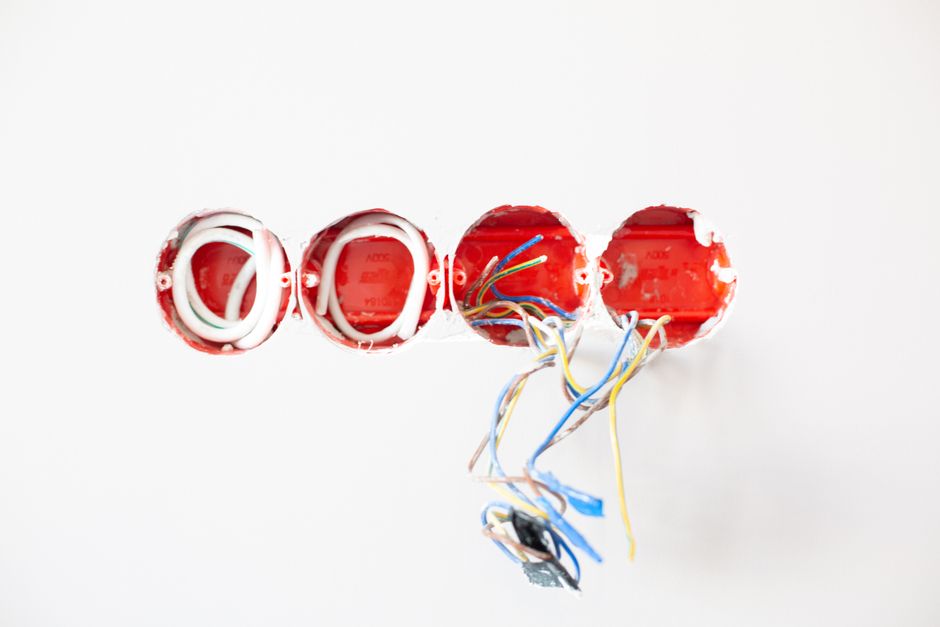
Before concrete is poured or block walls are plastered, your electrician installs PVC conduit pipes within walls, slabs, and columns to create the channels that cables will later pass through. Junction boxes, socket outlet boxes, and switch positions are also set at this stage. This work must be coordinated with the foundation and structural construction stages so that conduits embedded in slabs are not accidentally cut or omitted.
First Fix (Cable Pulling)
Once walls are up and plastered but before ceilings are closed, cables are pulled through the conduits. Separate circuits are run for lighting, power sockets, kitchen appliances, air conditioners, and the water heater. Each circuit is labelled and terminated at the distribution board location. At this stage, the earthing electrode (copper rod driven into the ground) is also installed and connected.
Second Fix (Fittings and Board Installation)
After painting and finishing, switches, sockets, light fittings, and the main distribution board are fitted and connected. The board must contain the correct MCBs (miniature circuit breakers), an RCCB or ELCB for earth fault protection, and a properly rated main isolator switch. The installation is then tested before the CEB or LECO inspection is requested.
Mandatory Wiring Components and Safety Features for Sri Lankan Homes
SLS 734 and CEB/LECO requirements together define a minimum set of components that every new home must include.
- Main distribution board with a rated isolator, MCBs for each circuit, and an RCCB (residual current circuit breaker) of 30mA sensitivity for socket and wet area circuits.
- Earthing system: a copper earth electrode with a resistance to earth of not more than 5 ohms, connected to all metal parts of the installation.
- Separate circuits for lighting, general power sockets, kitchen, air conditioners, and water heaters. Sharing a water heater on a general socket circuit is a common and dangerous shortcut.
- Weatherproof sockets and fittings for outdoor areas, garages, and bathrooms, with IP44 or higher ingress protection rating.
- Correctly sized cables: 1.5mm² for lighting, 2.5mm² for power sockets, 4mm² or 6mm² for air conditioners and water heaters, and larger for the main supply cable depending on load.
- Label and circuit directory fixed inside the distribution board cover identifying every circuit.
Smoke detectors are not yet universally mandated in Sri Lankan residential building codes, but fitting them is strongly recommended and increasingly expected by insurers on higher-value properties.
CEB and LECO Grid Connection Requirements
Before the Ceylon Electricity Board or LECO will energise your new home, you must satisfy their specific application and inspection process. The steps typically run as follows.
- Submit a new connection application with a sketch of the property and your building permit.
- A CEB or LECO inspector visits to verify that the external service entry point (meter board position, service cable entry, and main isolator) meets their requirements.
- Your licensed electrical contractor submits the Electrical Inspection Certificatealso called the Completion Certificate, issued after a licensed Electrical Inspector approves the internal installation.
- CEB or LECO installs the meter and provides the service connection once all documentation is cleared.
The Electrical Inspection Certificate is issued by an Electrical Inspector registered with the SLSEA. Without it, no utility will provide a supply connection. Budget three to six weeks for this process in most areas, longer in rural regions.
Common Electrical Wiring Mistakes in New Builds (and How to Avoid Them)
Most electrical problems in Sri Lankan new builds trace back to a handful of recurring errors. Awareness of these helps you ask the right questions of your contractor.
- Under-sizing the supply and board: Installing a 40A single-phase supply in a home with multiple air conditioners and a solar inverter will cause constant tripping within months of occupation.
- No conduit in slabs: Cables laid directly in concrete without conduit cannot be replaced when they fail, and they will fail eventually due to heat and moisture.
- Sharing the earth and neutral at sub-boards: In a multi-storey home with sub-distribution boards, combining earth and neutral (PEN conductor) incorrectly is a code violation that creates shock risk.
- Skipping circuit labelling: Unmarked boards make fault-finding dangerous and slow. It takes minutes to do properly and saves hours of future trouble.
- Not leaving conduit spares for solar: Adding solar later without pre-installed conduit routes from the roof to the inverter location means hacking finished walls or running unsightly surface trunking.
Solar Panel Wiring Considerations for New Homes
Planning for solar at the construction stage costs almost nothing extra and saves a significant amount down the road. The electrical wiring requirements for new house construction in Sri Lanka increasingly include solar-ready provisions, especially since net metering approval from the SLSEA is now straightforward for grid-tied systems.
During the rough-in phase, your electrician should install a dedicated conduit run from the planned roof mounting area to the inverter location (typically near the main distribution board). A bi-directional meter socket and a separate AC isolator for the inverter output should be provisioned in or adjacent to the main board. For full detail on integrating panels with your home wiring, see our guide on solar panel wiring installation for homes in Sri Lanka.
The net metering scheme administered through the SLSEA and CEB/LECO means any excess solar energy your home generates can be exported to the grid and credited to your bill. Pre-wiring for this during construction, rather than retrofitting, keeps your installation clean and code-compliant from day one.
Why Professional Electrical Installation Is Non-Negotiable
The electrical wiring requirements for new house construction in Sri Lanka cannot legally be carried out by an unregistered individual. Under the Electricity Act, only contractors holding a valid SLSEA licence are permitted to install, alter, or test electrical systems in buildings. This is not bureaucracy for its own sake. It reflects genuine risk. A poorly wired home is a fire hazard, a shock hazard, and a liability that undermines the entire value of your investment.
A licensed contractor carries professional indemnity, follows SLS 734 systematically, and is accountable to the SLSEA for the quality of their work. They will also manage the Electrical Inspection Certificate process on your behalf, something an unlicensed handyman cannot do.
Beyond compliance, experienced contractors bring practical knowledge that no checklist replaces: how to route conduits to avoid future plumbing conflicts, how to specify the right board size for the home you are actually building (not the minimum that passes inspection), and how to future-proof for EV charging or solar expansion. That expertise is the real value.
FAQ
What electrical standards apply to new house construction in Sri Lanka?
New residential wiring in Sri Lanka must comply with SLS 734the national standard published by the Sri Lanka Standards Institution. It covers circuit design, cable sizing, protective devices, earthing, and installation methods. CEB and LECO add their own service connection requirements on top of this standard.
Do I need an electrical inspection certificate before CEB/LECO connects my house?
Yes. An Electrical Inspection Certificate issued by a registered SLSEA Electrical Inspector is a mandatory document for all new CEB and LECO service connections. No utility will energise a new premises without it. Your licensed electrical contractor should arrange this inspection after completing the installation.
How many power circuits and lighting circuits does a typical Sri Lankan home require?
A three-bedroom home typically needs at least two lighting circuits, two or three general power socket circuits, one dedicated kitchen circuit, and individual circuits for each air conditioner and the water heater. Larger homes with multiple levels will need more. Your contractor’s load calculation will determine the exact number required.
What is the difference between a licensed electrical contractor and a regular electrician in Sri Lanka?
A licensed electrical contractor holds a valid registration from the SLSEA, which authorises them to legally install, test, and certify electrical systems in buildings. A regular electrician may have practical skills but cannot legally certify work or obtain an Electrical Inspection Certificate. For new construction, you must use a licensed contractor.
Can I plan for solar wiring during the construction phase of my new home?
Absolutely, and it is the smartest time to do it. During the rough-in stage, your electrician can install conduit runs from the roof to the inverter location, provision a bi-directional meter socket, and reserve space on the distribution board for the solar AC isolator. This avoids costly wall-opening and surface trunking if you add solar later.