
The epoxy flooring for commercial buildings benefits go far beyond a shiny surface: this system delivers structural protection, hygiene control, and long-term cost savings that cheaper alternatives simply cannot match.
For commercial property owners in Sri Lanka, where humidity is persistent, foot traffic is heavy, and maintenance budgets are stretched, understanding what you are actually investing in makes a real difference.
What Is Epoxy Flooring and How Is It Applied in Commercial Settings
Epoxy flooring is a resin-based coating system applied directly over a concrete substrate. It consists of two components, an epoxide resin and a polyamine hardener, that chemically bond when mixed and then cure into an extremely hard, seamless surface. The result is not paint. It bonds to the concrete at a molecular level, forming a layer that is typically 2 to 5 millimetres thick in commercial applications, though heavy-duty industrial systems can run thicker.
Installation starts with surface preparation, which is the most critical phase. The concrete must be ground, shot-blasted, or acid-etched to open its pores and remove any contaminants. Without proper preparation, even the best epoxy product will delaminate within months.
After priming, the base coat is rolled or squeegeed on, followed by a broadcast layer if anti-slip aggregates or decorative flakes are required, then sealed with a topcoat for UV resistance and abrasion protection. The full process typically takes two to four days, with cure time before light foot traffic at around 24 hours and full cure at 7 days.
Key Benefits of Epoxy Flooring for Commercial Buildings
The core epoxy flooring for commercial buildings benefits stem from its chemistry: it is hard, non-porous, and chemically inert once cured. Those three properties cascade into practical advantages across every type of commercial space. Below, each benefit is examined in the context that matters to Sri Lankan property owners and operators.
Durability and Load-Bearing Performance Under Heavy Use
Cured epoxy reaches a compressive strength of around 10,000 psi (pounds per square inch), which is comparable to high-grade structural concrete. That matters enormously in warehouses where forklifts operate daily, showrooms where wheeled display units get repositioned, and retail environments absorbing thousands of footsteps every hour.
Bare concrete, by comparison, dusts and pits under repeated abrasion. Vinyl tiles crack under heavy point loads and delaminate at seams. Epoxy stays intact and maintains its surface integrity for years under conditions that would visibly degrade both alternatives. A properly installed epoxy floor in a commercial warehouse in Colombo or Gampaha can realistically serve 10 to 20 years before any major remediation is needed.
Hygiene, Chemical Resistance, and Easy Maintenance
The seamless, non-porous surface is one of the standout epoxy flooring for commercial buildings benefits for food-processing facilities, pharmaceutical warehouses, laboratories, and commercial kitchens. There are no grout lines, no tile edges, and no micro-cracks where bacteria, moisture, or organic material can accumulate. A single mop pass covers the entire floor uniformly.
Chemical resistance is equally important. Epoxy withstands acids, alkalis, oils, and solvents that would stain or corrode most other flooring materials. In an automotive service bay or a hardware distribution centre, that resistance means spills are wiped up without leaving a trace, and the floor does not need re-coating every season to look presentable. Standard maintenance is just regular sweeping and occasional mopping with a neutral pH cleaner.
Safety Features: Slip Resistance and Fire Ratings
A smooth epoxy surface can be slippery when wet, but this is addressed during installation by broadcasting fine quartz or aluminium oxide aggregate into the wet topcoat.
The resulting texture, measured as a coefficient of friction, can be specified precisely for different zones: higher grip near loading docks or wet processing areas, smoother finishes in dry showroom or office environments.
For fire safety, most commercial-grade epoxy systems carry a Class B or Class C fire spread rating under standard fire resistance classifications. Some epoxy systems are specifically formulated with fire-retardant additives for spaces that require it. This is a detail worth discussing with your flooring contractor early in the specification process, especially for spaces with flammable storage.
Aesthetic Versatility for Retail, Office, and Industrial Spaces
Epoxy is not limited to the flat grey industrial look. Decorative options include metallic pigment systems that produce a marbled, three-dimensional appearance, broadcast flake systems that resemble terrazzo, and solid-colour high-gloss finishes in virtually any RAL or custom colour.
Logos and floor markings can be inlaid directly into the system, which is useful for warehouses needing traffic lanes or retail spaces building brand identity into their interior.
This flexibility means the same flooring system can suit a pharmaceutical cold-store (functional, light-coloured for visibility), a boutique showroom in Colombo (high-gloss metallic finish for impact), and a multi-tenant office building (neutral tones, low-maintenance). One material, many outcomes.
Cost Efficiency: Upfront Investment vs. Long-Term Savings
The epoxy flooring for commercial buildings benefits are most compelling when you look at total cost of ownership rather than the day-one price. Epoxy typically costs more per square metre to install than painted concrete or basic vinyl tiles. However, its lifecycle changes the maths entirely.
Consider a 500 sq m warehouse floor. Vinyl tiles installed at a low cost might need replacing every 4 to 6 years due to wear, delamination, and moisture damage under Sri Lanka’s humidity. Epoxy, professionally installed, requires only periodic topcoat refreshing (a much cheaper process than full removal and reinstallation) and can go 10 to 15 years before any significant intervention. Reduced downtime during maintenance cycles is also a real business cost. A floor that needs replacing means clearing inventory, closing the space, and losing operational days.
Lower ongoing cleaning costs, zero need for waxing or polishing products, and the absence of replacement tile purchases all contribute to a favourable total cost of ownership compared with alternatives that look cheaper on day one.
How Epoxy Flooring Compares to Other Commercial Flooring Options
Bare concrete is the baseline for most Sri Lankan commercial builds. It is porous, dusts under traffic, and absorbs oil and chemical spills permanently. Epoxy is applied over concrete and solves each of those problems without replacing the structural slab.
Vinyl or PVC flooring is affordable and quick to install but sensitive to moisture migrating up through concrete slabs, which is a genuine problem in Sri Lanka’s climate. PVC flooring also struggles under point loads from heavy equipment. Ceramic tiles perform well hygienically but grout lines accumulate dirt, tiles crack under fork lift traffic, and reinstallation after damage is labour-intensive.
Polished concrete is a strong competitor aesthetically but offers less chemical and moisture resistance than a full epoxy system. For spaces where hygiene, chemical exposure, or heavy loads are factors, epoxy outperforms it clearly.
Which Commercial Spaces Benefit Most from Epoxy Flooring
Warehouses and logistics facilities are the obvious primary use case: high loads, forklift traffic, spill risk, and a need for floor marking all point directly to epoxy. But the list extends much further.
- Showrooms and retail spaces benefit from the high-gloss aesthetic and easy cleaning between customer hours.
- Pharmaceutical and food facilities require the seamless, hygienic surface that epoxy provides.
- Car parks and service bays need chemical resistance and durability under vehicle loads.
- Hospitals and clinics require easy-to-clean, non-porous surfaces that limit pathogen accumulation.
- Offices and commercial building lobbies can use decorative epoxy systems to make a strong first impression while minimising ongoing floor maintenance.
If your space sees regular foot traffic, exposure to moisture or chemicals, or carries any kind of operational load, epoxy is worth serious consideration.
What to Expect from a Professional Epoxy Flooring Installation
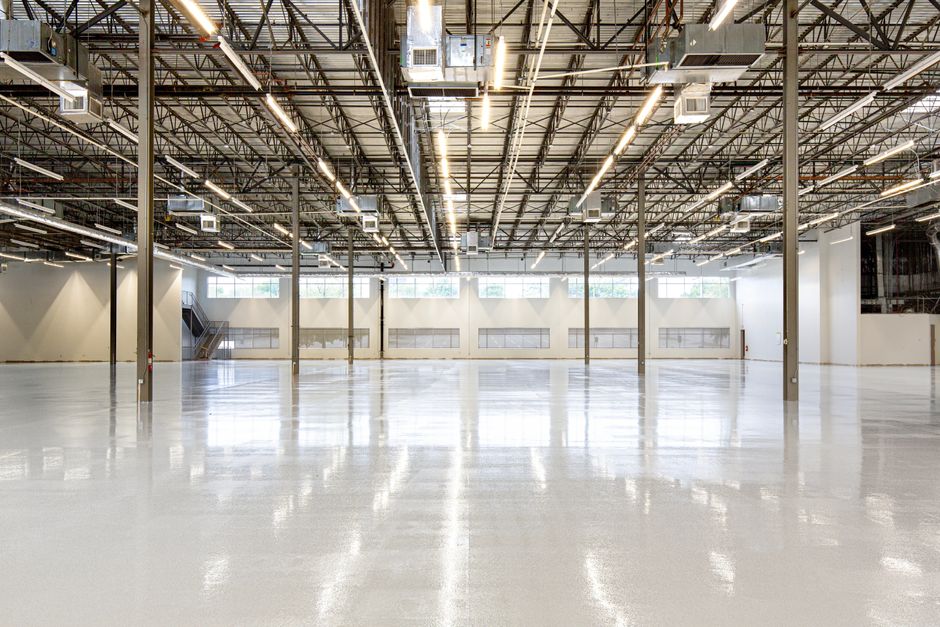
The performance you get from epoxy is almost entirely determined by the quality of the installation. Surface preparation, correct mixing ratios, ambient temperature during application, and the number of coats all affect how long the floor will last and how it will look.
Sri Lanka’s humidity adds a layer of complexity: high ambient moisture during application can cause epoxy to blush (turn cloudy) or fail to bond properly if the applicator does not manage conditions correctly.
A professional installation team will conduct a moisture vapour emission test on the concrete slab before starting, select the right primer for the moisture level, and schedule application during appropriate weather windows. They will also document the product batch numbers and coat thicknesses for warranty purposes. These are not steps a general labourer can improvise on site.
For commercial properties in Sri Lanka, working with a contractor experienced in both the material and local conditions is essential. Our professional flooring and wall finish services cover the full process from surface assessment through to final coat, ensuring you get the performance you are paying for.
FAQ
How long does epoxy flooring last in a commercial building?
A professionally installed commercial epoxy floor typically lasts between 10 and 20 years depending on traffic intensity, load type, and maintenance. High-traffic zones may benefit from a topcoat refresh every 5 to 7 years, which costs significantly less than full replacement and extends the system’s life considerably.
Is epoxy flooring suitable for humid or tropical climates like Sri Lanka?
Yes, provided installation is managed correctly. The key is controlling moisture in the concrete substrate before application and choosing a primer rated for high moisture vapour transmission. Epoxy resin systems are inherently moisture-resistant once cured, making them well-suited to Sri Lanka’s tropical conditions when applied by an experienced contractor.
What is the typical cost of epoxy flooring per square metre for commercial spaces?
In Sri Lanka, commercial epoxy flooring typically ranges from LKR 1,500 to LKR 4,500 per square metre depending on the system specified (basic solid-colour versus decorative metallic), surface preparation required, and the size of the project. Larger areas attract a lower per-square-metre cost. Always request a site-specific quote after a moisture and condition assessment of your existing slab.